A sea, then stone
Long before the peaks, this area was a shallow tropical sea. Shells, coral and fine carbonate mud accumulated on the sea floor, layer upon layer, and were compressed into limestone. Tectonic movement later lifted the bed above sea level and folded it, though the layers here are gentler than in a mountain belt.
The rock is the archive. If you look closely at a freshly broken surface, you can sometimes see fossils or thin bedding planes. The same planes and vertical joints are the routes that water has followed ever since.
Dissolving a landscape
Rainwater absorbs carbon dioxide as it passes through soil and air, becoming a weak carbonic acid. Limestone is soluble in that acid. Over hundreds of thousands of years, water widens cracks into channels, channels into caves, and caves into collapsed valleys.
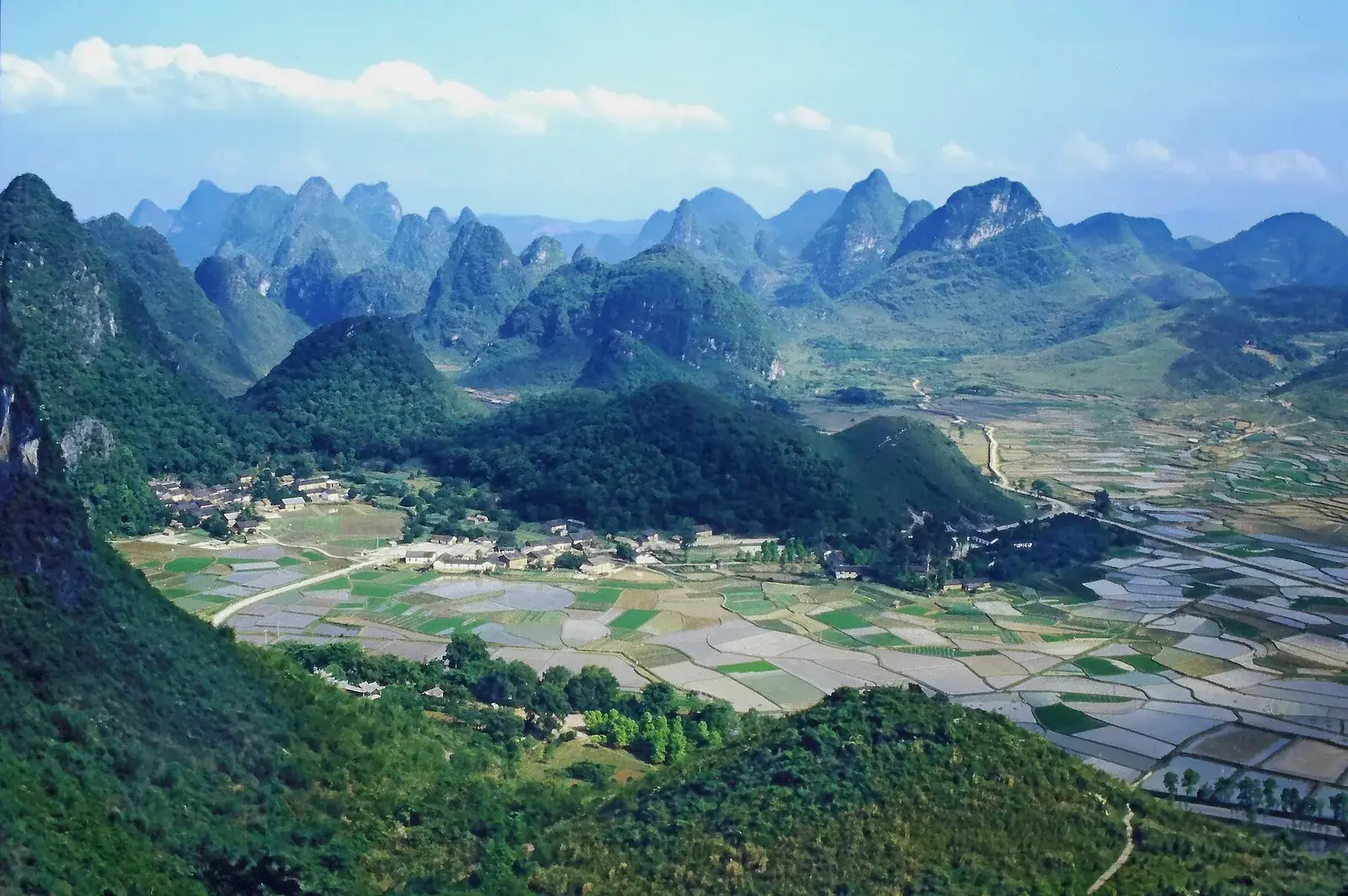
What remains is the harder, less fractured rock: isolated towers, conical hills and ridges. The process is called karst, after the plateau in Slovenia where it was first described. Yangshuo is one of the world’s classic tower-karst landscapes.
Reading the shapes
Not every peak is the same. Towers are steep-sided and often clustered; cones are broader and more rounded. Some hills are remnants of a continuous limestone cover; others are isolated reefs that resisted dissolution. The shape tells you something about the rock’s purity and fracture pattern.
The caves are part of the same system. Water that disappears underground in the hills resurges at the valley floor, which is why springs and wet patches appear where you least expect them. The rivers themselves are still cutting down through the old cave systems.
Why it matters to a traveller
Geology explains the practical details. The soil is thin and patchy, so the fields are small. The hills are steep and cannot be farmed, so the villages sit on the flat ground. The rock is good for climbing, but the holds are solution pockets and flakes, not granite cracks.
It also explains the light. The peaks cast long shadows and trap mist in the valleys. The best photographs are not just about sunrise; they are about the way limestone topography interacts with humid air.
Questions
Practical notes
Are the peaks volcanic?
No. They are sedimentary limestone that has been dissolved and eroded. There has been no recent volcanic activity here.
How old are the caves?
The cave systems are geologically young compared with the limestone itself, forming over the last few million years as the land was uplifted and water cut down through it.