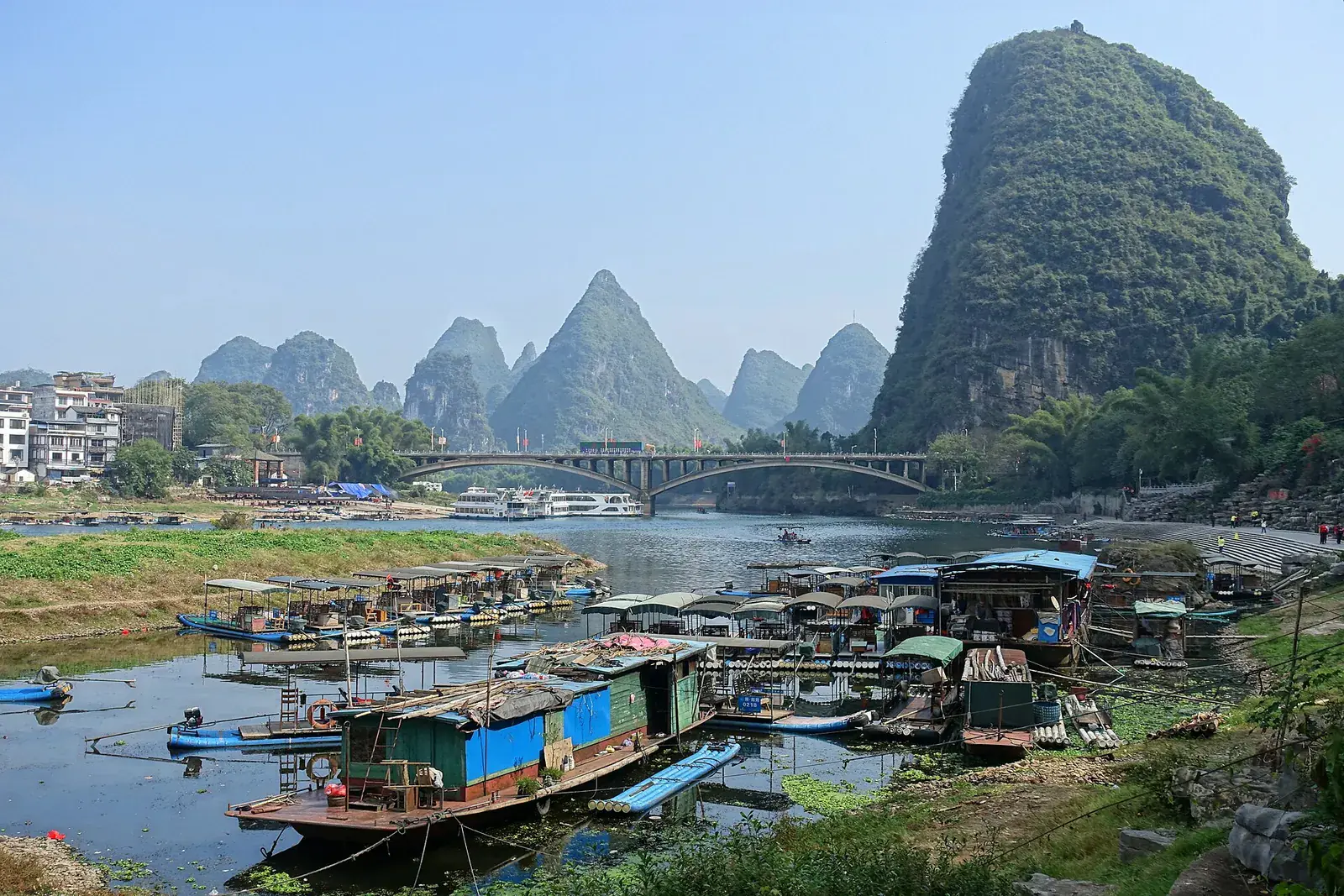
The river in two versions
There are two Li Rivers in the visitor imagination. One is a slow, misty corridor of peaks with a fisherman on a bamboo raft. The other is a four-hour cruise ship with a loudspeaker and a buffet. Both exist. They use the same water, at different hours, in different weather, with very different expectations.
The good version is not a secret; it is a timing decision. The tour boats leave Guilin in the middle of the morning and reach Yangshuo around lunchtime. If you are on the water before them, or south of them, the river can still feel like a place rather than a procession.
I would not take the long Guilin–Yangshuo cruise unless the journey itself is the point. For most travellers, the better move is a short private raft or a walk along the bank between Xingping and Nine Horse Fresco Hill, where the river bends and the peaks stack up.
What the water does through the year
The Li is a monsoon river. In late spring and early summer it can rise fast and turn the colour of weak tea. That is dramatic, but it is not always safe or photogenic; raft services may stop, and the famous reflection disappears. By autumn the water clears and slows, and the riverbed shows its stones.
Winter is low and quiet, often grey, occasionally magical in mist. The worst mistake is to assume that a photograph you saw in November will match the river in July. Check the water level and the forecast, not just the weather app’s little sun icon.
The hours that matter
Dawn is the obvious answer, but the useful window is narrower than most guides admit. In summer, first light is around 06:00 and the mist burns off quickly. In winter, the sun comes up later and the valley can stay soft until eight. The half-hour before sunrise and the hour after are usually the best of the day.
Late afternoon is the second window, especially on the west-facing bends. The light goes gold, then pink, then flat. Tour groups are heading back to town; the river empties. It is a shorter window than dawn, but it demands less sacrifice.
How to be on the water
There are three realistic ways to experience the Li: the long cruise from Guilin, a short motorised raft on the Yangshuo–Xingping stretch, or the bank on foot or by bicycle. The cruise is a sightseeing product. The short raft is a river experience. The bank is free and often better than both.
If you take a raft, agree the route and the price before you board, wear the life jacket, and do not expect silence. If you walk, start at Xingping and head upstream towards Nine Horse Fresco Hill; the path is obvious and the views open up within twenty minutes.
The private dawn day in these notes exists because this is the one part of Yangshuo where the difference between ordinary and excellent is almost entirely logistics.
Questions
Practical notes
Is the Li River cruise from Guilin worth it?
Only if you want the four-hour journey itself and are comfortable with a large boat. For most people, a shorter raft trip near Xingping plus time on the bank is a better use of a morning.
When is the water clearest?
Usually from late September through December, after the monsoon has passed. Spring and early summer are greener but more unpredictable, and heavy rain can make the river turbid for days.
Can I swim in the Li?
I would not. The current, boat traffic and variable water quality make it a poor idea. The Yulong has safer shallow spots, but even there you should follow local advice.