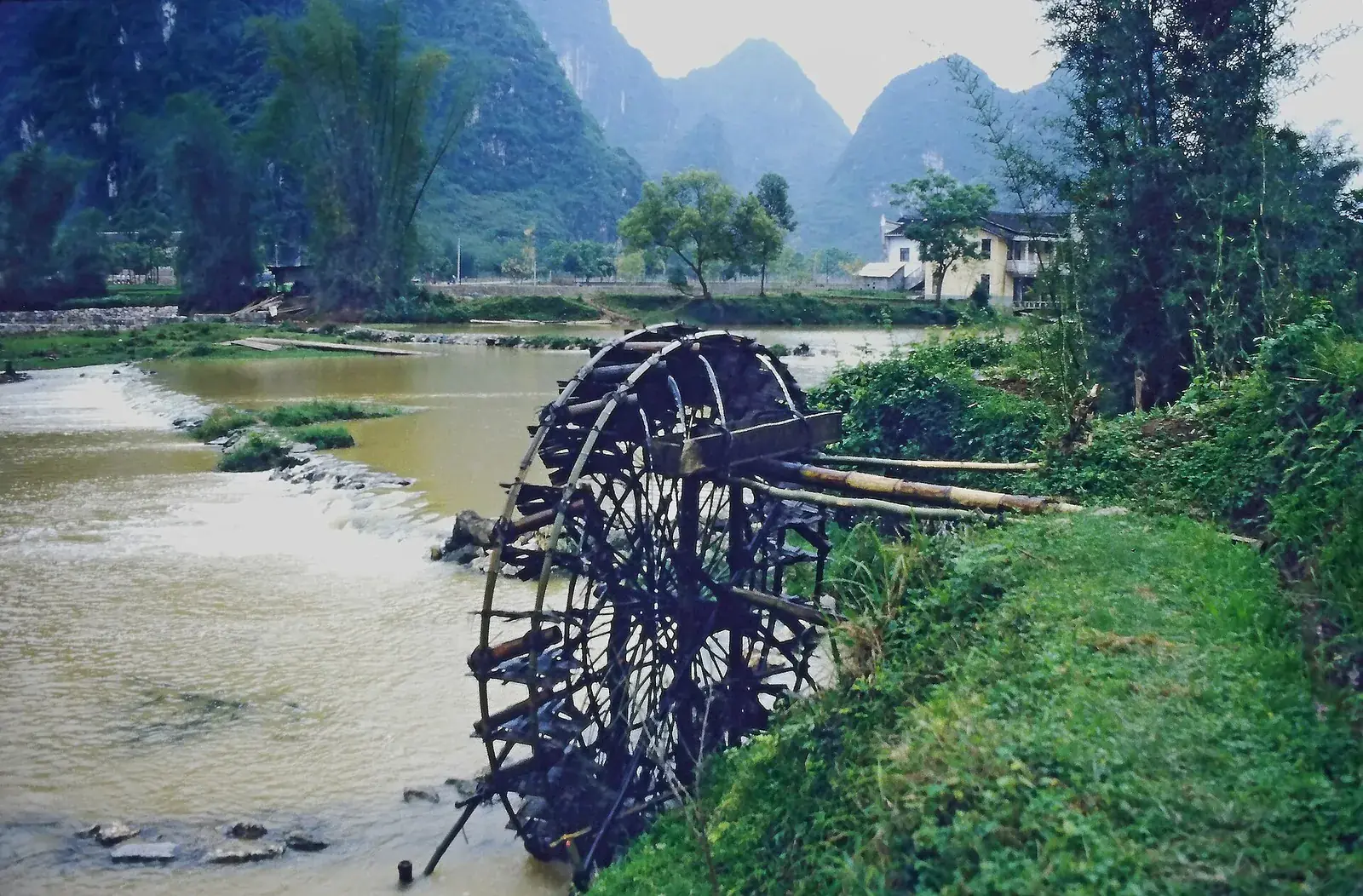
A settlement at the water’s edge
Langshi sits low against the river, with a small quay, a few old houses and lanes that end at the water. It is not a major sight, and that is its appeal. The pace is set by the river and the fields rather than by a tour schedule.
The architecture is modest: brick, timber, whitewash and tile. Some buildings are empty; others are clearly cared for. The old water wheel and the stone edges are reminders that this was a working river village before it was a place to visit.
The view
Looking back upstream from Langshi, the peaks arrange themselves into the same dramatic stack that draws people to Xingping. The difference is that you are seeing it from the opposite bank, with fewer people and more foreground.
Late afternoon is the best light. The river can be glassy, and the karst reflects in it. In the rainy season the water may be brown, but the scale of the landscape is still impressive.
Getting there and away
Langshi is about 6 km south of Xingping on the east bank. The road is narrow and partly concrete, with a few rough patches. A bicycle is ideal; a taxi can get you close, but the last lane may need walking.
There is no regular visitor boat service. If you want to arrive by water, arrange it through a guesthouse or a private boat operator. Do not assume you can flag down a raft.
Practical notes
There are very limited services: perhaps a small shop, no reliable restaurant, no ATM. Carry cash and water. The village is not set up for a long stay.
Combine Langshi with Puyi and the east-bank lanes for a half-day ride. If you are short on time, choose Xingping instead; it has more facilities and a more dramatic view.
Questions
Practical notes
Can you stay in Langshi?
There are a few simple guesthouses in the area, but it is not a practical base for most visitors. Stay in Xingping or Yangshuo.
Is Langshi crowded?
Usually not. It is far enough from the main tour routes that you may have the quay to yourself.